
I will give you a hundred percent that every businessman wants to be a leader in a particular niche. This businessman does all his best to be ahead of the game; however, practice shows that the way from “the outhouse to the penthouse” is not possible in the world of internet business.
Even if you think you are skillful in a business niche you represent, it doesn’t mean you’ll reap the benefits at once.
You will have to cover a long way before you will attract an eye on yourself.
You will have to build a communication with potential clients, build business relationships with influencers and broaden various contacts.
All these stages could be achieved with the help of such a great strategy called Email Outreach.
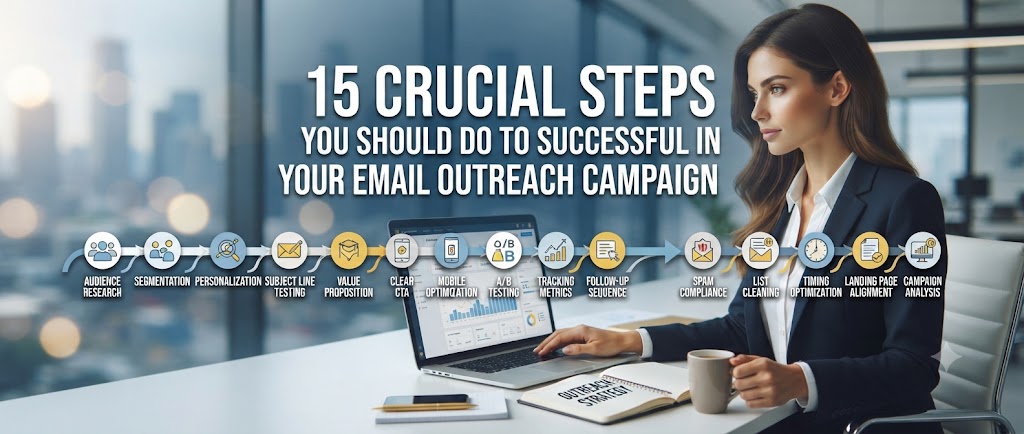
In this guide, I am going to share with you 15 crucial steps you should do if you want to succeed in your business.
Let’s start.
SIDENOTE: If you are interested in how to do a keyword research in this year, you should check out this guide.
1. Start with Yourself. Take Care of Your Professional Background
The first thing I want to do is to put a question over to you: “How often do you reply to the messages you get from a person you know nothing about ?” I am sure you will tell me something like: “Such messages seem suspicious to me” or “I reply if I can see that the sender has a solid profile info”.
The same thoughts appear in a head of the person you’re willing to reach out to.
Thus, if you want him or her to take your message seriously, you should take care of your profile information.
Here are a few major attributes you must follow:
- Valid email address (don’t create fake email for business purpose)
- Social media accounts with completed profile info
- Personal contacts as a cell number, Skype, Whatsapp or Viber
Furthermore, you should show almost a daily activity on your social media channels. Let people know that you are a real person who prefers to be community-minded.
Once you have a complete professional profile with a valid email address, it is time to search for potential targets.
2. Social Media – One of the Best Ways to Find New Prospects
I won’t argue the statement that Social media is mostly used for entertainment. But it doesn’t shy away from a development of business relationships too.
It looks like you already have the accounts throughout such social media platforms as Facebook, LinkedIn, Twitter, and Google +. I could mention other resources but these 4 are in use the most.
You can find new prospects using social media platforms in one click. This is due to the fact that these platforms suggest people you would like to connect regarding the niche you are.
For example, I work as an internet marketer and SEO; thus, my niche is determined by Internet marketing. Let’s see what LinkedIn suggests:
As you can see all these people are devoted to the niche I bustle about. I can take this opportunity and try to connect with them. Afterwards, I will have new business contacts and customers.
Twitter suggests you who to follow as well:
I believe there is no need in providing you with the other examples of social media platforms’ performance. Yet, people always share links to their social media channels on the web. Thus, it won’t be hard for your to find them to connect with.
3. Technical Ways to Find New Prospects
From my perspective searching new prospects using social media platforms is not as resultative as it is using more technical ways. I personally devote to technical ways and it helps me grow my network with a blink of an eye.
Basically, everything you need here is Google and Ahrefs Site Explorer tool. That’s all.
Google – Let’s presume you’ve just released some awesome service that would be useful for people from Video marketing niche. You know for sure that it worth using but you don’t have customers to offer this service. Then you will have to ask Google’s help in revealing sources where you could get new prospects. Put in a search bar a query like “video marketing” and Google will show you a list of web resources related to it.
Now, when all the best results for your query are presented, it is time to do a further research.
Ahrefs Site Explorer – The next step is to do data mining. Here you need Ahrefs Site Explorer tool. It works simply. Put a link you would like to investigate into a search bar and see how many backlinks it has.
4. Forget About Third-Party Email Addresses. Focus on Searching Only Private Ones
It goes without saying that you could use your social media connections to get in touch with the customers. But, hold on. You should never mix your business with personal relationships. It is inappropriate to reach out your customers on Facebook offering them your service. It is a kind of a “space rape”. You are not a close friend but a random businessman who sends a message thinking about benefits you could get. Thus, using direct email addresses is the best way to show your professional credibility and to discuss your business offer.
I recommend you a few ways how to find personal email addresses.
- Investigate person’s contact information on Social media
- Use special tools for “email hunt”
It is not surprising to hear that you’ve stumbled upon the profiles on Social Media with contact details mentioned. I must confess that the first thing I do when I want to find a personal email address, I visit LinkedIn, Google+ and Facebook first.
Here is what you can find on LinkedIn:
And what Google+ offers you:
I suggest you focus yourself on discovering the information only on LinkedIn and Google+ because practice shows that people rarely point out their email addresses on Facebook.
If you don’t want to waste your time on social media accounts, you can use such tools like find.that email and voilanorbert. But make sure you know person’s full name and a current company he or she works for. These tools require this data to find a personal email address correctly.
5. Show Yourself First
Sometimes it is hard to build new relationships with random people. Not sure about you but I feel myself awkward when I need to get in touch with a stranger. I don’t know where to start, what to say, which approach to choose. I bet there are lots of people face the same problem as well. But you must build new business relationships for all costs.
Now put yourself in a customer’s place. You receive a message from a person you know nothing about. This stranger is trying to pitch you with some service from the very first message. Would you like it?
Even if you don’t consider such messages as a kind of insolence, I am sure you would be puzzled whether to reply to it or not.
Thus, it is strictly important to let your customer know a thing or two about you before offering him or her your service.
Thanks to Social media you have a great opportunity to make your customers familiar with you in advance. Simply, follow your potential customers on Twitter, build a connection on LinkedIn. Don’t hesitate to congratulate prospects with a B-Day or a work anniversary, whatever. Your aim is to make them memorize you. Afterwards, your customers will stay abreast of who is reaching out them.
6. Try to Discover More Background Information About Your Customers
Are you familiar with the statement “Master of information, master of situation”? This expression fits ideally to the process of building business relationships. Just imagine, you want to reach out your customer but you don’t know how to ‘hook’ him or her. Ordinary email templates don’t work, your message hasn’t been even read. What to do?
In this case, I highly recommend you to devote yourself to discovering person’s background information. Hobbies, interests and preferences your customers might have.
What is the aim of this research?
You will be able to create more personalized email templates. The more email is personalized, the more chances you have it will be read and replied.
The way how this information could be used I will show you ahead.
7. Think the Subject Line Though
The subject line is the first thing your recipient draws attention to. Thus, it is very important to “force” the person you’re reaching out to open the message. If he or she can clearly see that the subject line seems to be weird, the message won’t be opened.
I would divide all subject lines into two groups – personalized and short-form.
Personalized subject line should contain the elements that have an avid connection with person’s background information. For example, your customer is fond of history and cigars. It could be easily used in the subject line:
Short-form subject line should reflect the main purpose of the message you send:
Of course, you can adjust the subject lines according to your own preferences. However, the reality is that the variations I introduced to you work the best.
8. Borrowed Email Templates Are Good but Don’t Use Them
I know you might have a desire to use those templates that famous marketers had created before. You rely on a credibility these templates have. I can’t argue with you on this term. These templates work for 100%. But, wait a minute. You didn’t create them. You just want to use them. That’s the main difference.
The trick is that the patterns in borrowed email templates strike recipient’s eye at once. It will be a clear indicator for him that you didn’t spend your time writing a message; you just “copy/paste” it.
As the result, your message won’t be read.
You can use the other templates as the examples for creating your own ones but nothing more.
9. Personalize Each Email Template
We’ve just got to the most interesting step of Email Outreach strategy – email template personalization. This step requires your creativity and patience. So, be ready to spend hours working with your imagination.
I was talking about person’s background information in my step 6. I promised you to explain further why you need this data making an email blast. For better understanding this concept, I would like to present you a few examples to compare first:
What is the first thing that arrests your attention? The absence of the name, right? The person who sent me this message didn’t do any kind of research about my persona. I am sure he knows nothing about me but he strives for promoting his content, that’s all. I don’t consider such type of messages at all.
And here is the example of how we prefer to do our outreach at Ahrefs:
This template differs quite impressive, isn’t it? Here I took care of all aspects of personalization, starting from a subject line ending with “Introduction” section. Now I can say this email seems to be quite personalized, short and to the point.
To be honest with you, the process of personalization isn’t hard. It has no secrets. It just needs you to work with customer’s background information and be able to mix it with the main message. That’s all.
10. Avoid Using Generic Patterns
The major part of the messages you get contains special patterns. These patterns show that the message you’ve got has been generated automatically. So, it wasn’t personalized. Here are the patterns I am talking about:
The arrows point out to these patterns I recommend you to avoid. Easy to say but a bit complicated to do. You might think that if you remove these patterns, it might change the whole structure of the message. Yes, you are right. But I am talking about not removing ALL patterns, just a few of them. Let me give you a visual example:
I didn’t avoid some of the patterns too. But I’ve made the message more personal sharing my own thoughts about the post this recipient had written before. Moreover, you can see that the subject line is short and it carries the message.
11. Focus on your customer first
Both you and your customers know what the purpose of email outreach is. It is not hard to guess. You don’t want to invite him or her to a cup of coffee. You want to pitch a service. But what about these people you’re reaching out? Do they feel themselves interested in your offer reading the messages you send?
If they see only your proposition and nothing more, they won’t consider your message seriously. It will be like another one random message from a “cold” email outreach. However, you are willing to resonate with the customers and push your offer forward.
You should make your customer the main subject of your conversation. Rather than describing and selling your products, I recommend you to listen to your prospect. Try to find out his or her opinion about the service you offer. If the person is not familiar with your brand, try to share the basics of what you offer in a friendly manner. Never persist on buying your product. Your first aim is to hook a customer. Afterwards, you can get back to the meat.
12. A Few Words About Right Time for Email Pitch
Definitely, a time zone plays a huge part in sending emails. Nevertheless, it is possible to predict when it would be better to do outreach.
I experimented with the days sending messages during the whole week and here is what I found out.
- Monday. The first day after weekends. As the rule, an inbox is always full of fresh messages. It won’t bring you the results if you decide to do outreach during this day.
- Tuesday. There is still a bunch of messages that users must check after weekends. However, if you send the message during this day, there are chances it might be noticed.
- Wednesday to Friday. A middle of a working week that comes to end. Inbox seems to be not so overload with the messages. These are the best days to do your outreach.
- Weekends. I practiced outreach during the weekends. I can’t give you an absolute answer on this matter. Sometimes my messages hit the target, sometimes not. As for me, I check my inbox during the weekends. Who knows, maybe other users do the same?
13. Analyze Template’s Open Rate
Email outreach successfulness depends on email templates you use. You can’t predict how a particular template works. Furthermore, you don’t know for sure if your templates worth using at all.
Luckily, thanks to Buzzstream it is possible to track the progress of your outreach.
We have to run lots of outreach campaigns here at Ahrefs. Thus, it is significantly important to us to know each email template success rate. This “success rate” includes the following metrics as open rate, clicks, and replies. According to these metrics, we can clearly see which email template works great and which is should be deleted:
On the screenshot above you can see that three templates from a single project work perform in different ways. I won’t say there is an avid leader among them but open and reply rates have a percentage that varies. We decided to send 100 messages using each template one by one. Afterwards, we had clear results showing which template is far better to use in the future. It is a very convenient way to succeed in terms of template “powerfulness”.
Another one awesome feature Buzzstream offers is tracking message status. In other words, it shows if the message has been seen or replied:
Using Buzzstream (or other similar tools) you will stay in a loop in your outreach process.
14. Follow-Up Email Is Necessary but Do It Wisely
The cases when your message goes under the radar happen pretty often. There are various reasons why the recipient doesn’t reply your message. It might be caused due to the fact the person was busy. You must understand that people in a digital world get dozens of messages every single day. Your message could be simply lost among others.
Fortunately, you can send a follow-up email.
Just for the record, follow-up messages have 30% higher response rate in contrast to the first message you send. Keep it in mind and follow up.
I would like to give you my own examples that will prove you the effectiveness of follow-up messages. Firstly, you should realize that you can send a follow-up email in a few days after your first attempt:
However, the other cases require waiting even more, for a few months:
I hope my examples have proven you a necessity of sending follow-up emails.
15. React Fast and Build Long-Term Business Relationships
This endless business race requires you to be fast and furious. If you are slow you won’t win the game.
Your competitors never sleep; they constantly build new business connections and enlarge their customer database.
It doesn’t matter what business you run, the matter is to act fast and stand to benefit from the contacts you have. For better understanding what I mean, let me provide you with one example from my practice.
Once I have dealt about publishing a guest post on a blog. The owner of this blog was happy to accept my article but it wasn’t published there. And do you know why? He had no time to review my post for a few weeks in a row. He even didn’t get in touch with me.
I couldn’t wait anymore and I submitted my post on the other blog.
I notified the blogger about my actions offering him a brand new material from me. Here is the extract from our correspondence:
Again, pay attention to the date. He replied me in 15 days after my notification. Gosh, this man won’t be a leader in his niche.
My example illustrates you how it is important to act as quick as a flash. Otherwise, you might lose your chance to hit the jackpot.
To Conclude
Email outreach is a sequential process that involves many small but important tactics in it. One missed element won’t let you move ahead. Consequently, an in-depth research, data mining, patient and your persistence are those aspects you will have to never forget about.
I hope these 15 steps have revealed you how to do Email outreach correctly, fast and efficient.
Please, feel free to share other insights you know in a comment section. I would love to read them though 🙂
And don’t forget to click on “share” button to spread this material throughout your social media channels.