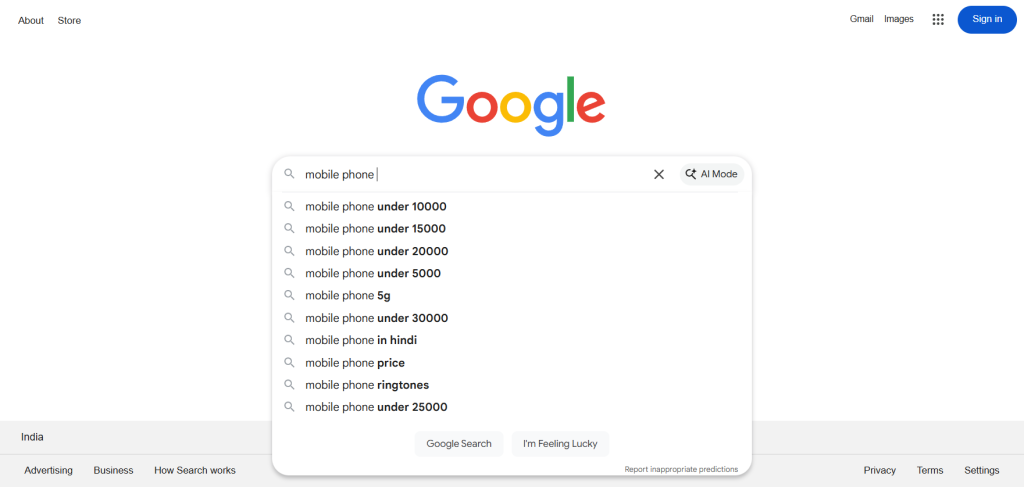

Keywords still matter—but not in the way they used to.
When you type a query into Google or enter a prompt into Gemini, you expect results that actually answer your question. That expectation highlights how far search has evolved beyond simple keyword matching.
Think about it this way:
If you search for “best mobile of 2026,” you wouldn’t expect to see a result about the Indian President. Even if that page is highly authoritative, it’s completely irrelevant to your intent.
Now consider a different scenario. You search for “top moible phones,” and a page ranks that doesn’t include those exact words in its title. Would that surprise you?
Probably not.
As humans, we naturally understand that these phrases mean roughly the same thing. And increasingly, so does Google.
Search Has Moved Beyond Exact Keywords
Modern search is powered by advances in machine learning (ML) and natural language processing (NLP). These technologies help Google understand:
- Synonyms (e.g., “Android” vs. “IPhone”)
- Context and intent
- Semantic meaning behind phrases
This means Google no longer relies on exact-match keywords to determine relevance.
Even back in 2012, Google could connect terms like “cell phone,” “mobile phone,” and “cellular phone.” Fast forward to 2026, and search engines can interpret full, conversational queries like:
“What’s the best budget Android phone with a good camera?”
Users now search in natural language—and expect accurate, context-aware answers.
What the Data Says About Keywords Today
To understand how much keywords still matter, researchers analyzed:
- 1,000 long-tail queries
- 8,703 page-one Google results
They compared search queries with result titles using three types of similarity:
1. Exact Match
Only 0.49% of results contained the full query.
That means over 99% of ranking pages did not use exact-match keywords in their titles.
This alone shows how outdated traditional keyword-stuffing strategies have become.
2. Partial Match (Jaccard Similarity)
This method measures how many words overlap between a query and a title.
- Average similarity score: 0.23 (low overlap)
Even top-ranking pages often share only a few words with the original query.
3. Semantic Match (Cosine Similarity)
This is where things get interesting.
Semantic similarity measures meaning—not just words.
- Average similarity score: 0.76 (high relevance)
In many cases, pages ranked highly even when:
- Word overlap was minimal
- Or there were zero shared keywords
For example, a query about “mobile overheating” could match a page discussing “mobile battery issues”—different words, same meaning.
Google Now Understands Intent, Not Just Words
One of the biggest shifts in modern SEO is this:
👉 Google focuses on intent, not exact phrasing.
It can now:
- Connect related ideas
- Interpret abbreviations (e.g., “EV” = electric vehicle)
- Recognize context across different word choices
You’ll even notice Google highlighting relevant phrases in search results—showing it understands not just the topic, but the answer itself.
What This Means for SEO in 2026
Keywords are still important—but their role has changed.
What no longer works:
- Keyword stuffing
- Over-optimizing for exact-match phrases
- Creating separate pages for slight keyword variations
What works now:
- Writing naturally for users
- Targeting topics, not just keywords
- Building content clusters around search intent
- Covering related concepts and questions
Instead of focusing on a single keyword, you should think in terms of:
👉 Semantic relevance and topic depth
The Rise of AI Search and What’s Next
With AI-powered search experiences like Gemini, search is becoming even more context-driven.
Google uses technologies like:
- Vector embeddings
- Semantic matching
- AI-generated responses
These systems analyze meaning at a much deeper level than traditional keyword matching ever could.
As search continues to evolve into a mix of organic results and AI-generated answers, this trend will only accelerate.
Bottom Line
Keywords still matter—but not as exact strings.
In 2026, success in Google Search comes from:
- Understanding user intent
- Creating meaningful, comprehensive content
- Targeting topics instead of isolated keywords
The future of SEO isn’t about matching words—it’s about matching meaning.